
Black Rhino Tracking in Damaraland: The Complete Guide
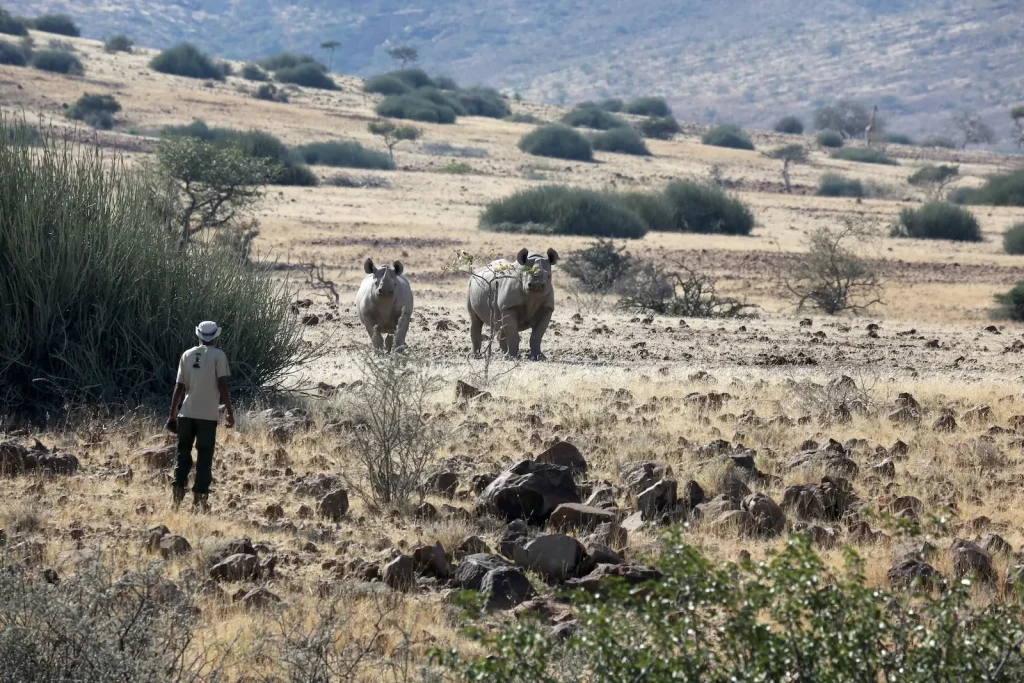
There is a moment, after perhaps two hours of silent walking across broken, stony ground, when your tracker stops, raises a hand, and points into a thicket of euphorbia and !nara bush. And there it is: a desert-adapted black rhino, breathing slowly in the mid-morning warmth, seemingly unaware that you are standing twenty metres away. Nothing in a vehicle-based safari quite prepares you for the physical reality of being on foot with one of Africa’s most critically endangered animals.
Damaraland, and specifically the vast Palmwag Concession in its north-western corner, is home to the world’s largest free-roaming population of desert-adapted black rhino. Tracking them on foot with the rangers of Save the Rhino Trust is, without question, one of the most extraordinary wildlife experiences available anywhere in Africa.
This guide covers everything you need to plan the experience, the wildlife biology, the tracking process, the best lodges to use as a base, when to go, and what makes this population so globally significant.
Quick Facts
| Species | Black rhinoceros (Diceros bicornis bicornis) |
| Population in Damaraland | ~200 individuals (Palmwag Concession & surrounds) |
| Status | Critically Endangered (IUCN) |
| Best experience | On-foot tracking with Save the Rhino Trust rangers |
| Best base | Desert Rhino Camp (fly-in) or Palmwag Lodge (self-drive) |
| Best season | Year-round; May–October for cooler tracking conditions |
| Duration of activity | 2–5 hours on foot |
| Fitness required | Moderate, uneven terrain, no extreme elevation |
Why Damaraland’s Black Rhino Are Globally Significant
The black rhino population centred on the Palmwag Concession is not just large, it is one of the few large black rhino populations in the world that lives completely unfenced, in its natural desert environment, ranging freely across more than 580,000 hectares of wilderness.
Globally, black rhino numbers collapsed from around 70,000 in the 1970s to fewer than 2,500 by the mid-1990s, a decline of over 96% driven almost entirely by poaching for horn. Namibia’s north-western population survived this catastrophe largely because of its remoteness and the early intervention of community-based conservation, most importantly the work of Save the Rhino Trust, which has monitored and protected this population since 1982.
Today Namibia holds more black rhino than any other country outside South Africa, and the Damaraland/Palmwag population is its crown jewel. Understanding that context gives the tracking experience a weight and significance that goes far beyond the individual animal you encounter.
Desert-Adapted vs Savanna Black Rhino: What’s Different?
The black rhino of north-western Namibia are not a separate subspecies, they are the same Diceros bicornis bicornis found elsewhere in southern Africa. But decades of living in extreme aridity have shaped their behaviour profoundly.
They cover vast distances. Savanna black rhino typically have home ranges of 10–20km². Desert-adapted individuals in Palmwag can range over 500–2,000km² in search of food and water. This is why locating them requires expert tracking rather than a simple drive to a waterhole.
They drink infrequently. Where savanna rhino drink every 24–48 hours, desert-adapted rhino have been recorded going up to five days without water, obtaining much of their moisture from succulent plants.
They are active at different times. To avoid the worst of the heat, these rhino are most active in the very early morning and late evening, which is exactly when tracking conditions are best.
Their diet is adapted. The Palmwag landscape is dominated by !nara melon, euphorbia, shepherd’s tree, and mopane. The rhino here have adapted to browse species that are toxic or unpalatable to most other large mammals.
These adaptations make every tracked individual a story of extraordinary resilience, and they make the encounter feel genuinely earned.
The Tracking Experience: What Actually Happens
Before You Go Out
Your tracker, typically a ranger from Save the Rhino Trust (SRT) who has monitored specific individuals for years, will brief you the evening before or early morning. SRT rangers know most animals in the Palmwag population individually. They track rhino movements daily whether guests are present or not, which means they usually have a good idea of where specific animals were last seen and where they’re likely to be.
You’ll be advised on clothing (neutral colours, no bright whites or blues), footwear (sturdy closed shoes or boots, the terrain is sharp), and behaviour in the field (silence, no sudden movements, following ranger instructions immediately and without question).
The Walk
Tracking begins at or before sunrise. Your ranger will pick up the spoor, typically large, three-toed prints in soft sand or scuff marks on rocky ground, and begin following. Progress is slow and deliberate. You may walk for an hour with nothing more than tracks to show for it, then find a fresh midden (dung pile) that tells the ranger the rhino passed through within the last few hours.
The landscape you move through is extraordinary in its own right, volcanic hills, dry riverbeds, colonies of euphorbias that look like they belong on another planet. The silence is absolute. The Damaraland photography guide covers how to make the most of this light and terrain if you’re carrying a camera.
The Encounter
When the ranger locates the rhino, the group approaches slowly from downwind. The SRT follows strict protocols around approach distance (typically 20–50 metres depending on the individual animal’s temperament and the terrain). Some animals are well-habituated to respectful human presence; others are less so, and the tracker will make a quick decision about how close to approach.
You will be asked to stay still, stay together, and stay behind the ranger. If the rhino moves towards you, which occasionally happens out of curiosity or irritation, the tracker will give a quiet instruction. In years of guiding this experience, genuine dangerous charges are extremely rare when proper protocols are followed.
What you’ll remember is not the adrenaline but the intimacy. A two-tonne animal browsing on euphorbia within shouting distance, seemingly unconcerned by your presence, in a landscape unchanged since the Pleistocene. It is genuinely humbling.
Duration and Physical Demands
Most tracking sessions last between two and five hours on foot. The terrain is uneven and rocky, requiring reasonable fitness, there is no extreme elevation, but you need to be comfortable walking on rough ground for extended periods. The heat builds quickly after 09:00, so early starts are essential. Carry at least 2 litres of water per person. Read our packing list for full desert-day preparation.
Where to Stay: Best Lodges for Rhino Tracking
Desert Rhino Camp (Wilderness Safaris): The gold standard
There is no better base for black rhino tracking in Africa. Desert Rhino Camp is a fly-in luxury tented camp in the heart of the Palmwag Concession, operated in partnership with the local community and with direct SRT ranger involvement in all tracking activities. Guests here have the highest probability of successful encounters because the camp has the deepest relationship with the SRT ranging network.
The camp itself is exceptional, eight spacious tented suites, a swimming pool that feels miraculous in the desert heat, and guided activities beyond rhino tracking including wildlife drives, Hartmann’s mountain zebra encounters on the Etendeka Plateau, and walks that showcase the extraordinary desert flora.
Access: Fly-in from Windhoek or Swakopmund (charter flights to Palmwag airstrip). No self-drive access into the concession beyond Palmwag Lodge.
Palmwag Lodge & Camp: Self-drive accessible
Palmwag Lodge sits at the eastern entrance to the Palmwag Concession and offers rhino tracking as a guided day activity. The tracking here still involves SRT rangers and is excellent, you simply have a longer drive into the concession before the walk begins. Palmwag also has a campsite, making it accessible for overlanders and budget-conscious travellers. Read our full lodge comparison for a detailed breakdown.
Access: Self-drive via C35; all vehicles but high-clearance 4×4 recommended.
When to Go
Rhino tracking is possible year-round, but conditions vary meaningfully.
May–October (dry season) is optimal. Cooler temperatures make the walking more comfortable, and reduced vegetation makes tracking spoor easier. Animals concentrate around water sources, slightly improving predictability of location. Clear skies are good for photography. This is also Damaraland’s peak season generally, read our best time to visit guide for the full picture.
November–April (green season) brings higher temperatures (35°C+ is not unusual), more lush vegetation (harder to spot animals in cover), and the possibility of afternoon thunderstorms. However, green season has its own rewards: dramatically moody skies, wildflowers on the Etendeka Plateau, and significantly fewer visitors. Some tracking operations are interrupted after heavy rain makes roads impassable.
Conservation Context: Your Visit Matters
Every paying guest who tracks rhino with an SRT ranger generates direct income for the conservancy communities and for the trust’s ranging programme. SRT rangers are drawn from local communities. Damara and Himba families who live alongside these animals. When ranger jobs exist and community income is generated by live rhino, the incentive to protect them, and to report suspicious activity to authorities, is profound.
This is the core logic of Namibia’s community conservancy model, and it is why Namibia’s north-western rhino population has grown while populations elsewhere have continued to decline. Choosing rhino tracking as an activity is not just a great experience, it is an act of direct conservation support.
Read our full piece on Save the Rhino Trust for the complete story of how this population was protected and what the future looks like.
Practical Tips
- Book well in advance. Desert Rhino Camp operates at small capacity and is consistently in high demand during peak season (June–September). Three to six months advance booking is advisable.
- Bring a telephoto lens. While you do get close, having a 200–400mm lens means you capture quality images without compromising the distance protocols. See our guide to photographing desert wildlife for technique advice that applies equally to rhino.
- Wear muted colours. Olive, khaki, brown, grey. Avoid white, black, and bright colours entirely.
- Listen to your ranger. SRT rangers are among the most skilled field professionals in Namibia. Their instructions in the field are not suggestions.
- Manage your expectations. Rhino tracking is not guaranteed. These animals range enormous distances in wild terrain. On most tracking sessions guests get an encounter, but not every session delivers, and that uncertainty is part of what makes it real. If you don’t find one on day one, day two is very often successful.
Combining Rhino Tracking with a Wider Damaraland Itinerary
Rhino tracking pairs naturally with desert elephant encounters on the Huab River, a visit to Twyfelfontein’s rock engravings, and time on the Etendeka Plateau. Our 7-day Damaraland itinerary includes rhino tracking as its centrepiece and builds a comprehensive circuit around it.
If you’re combining Damaraland with Etosha, read our Damaraland to Etosha connector guide for the best routing.
Plan Your Rhino Tracking Experience with Mat-Travel
Booking rhino tracking requires co-ordination between your lodge, the SRT ranger schedule, and your wider Namibia itinerary. Our team handles all of that seamlessly. Several members of the Mat-Travel team have personal relationships with the SRT rangers in Palmwag, it is the kind of knowledge that makes a real difference when it comes to getting the most out of your time in the field.
Contact us to start planning, or explore our Damaraland itineraries for inspiration.
NWR campsite bookings and vehicle hire through to NamibRand private lodge stays and guided dune photography programmes.