
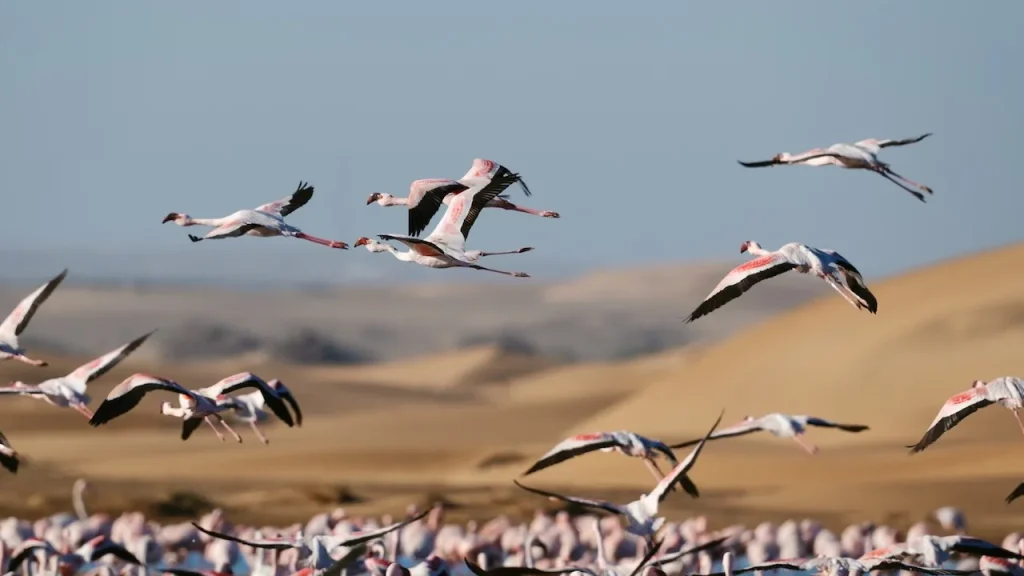
The flamingo of Walvis Bay are present year-round and in numbers that make the lagoon one of the most productive flamingo viewing locations on the continent. The question is not whether you will see flamingo; it is how many and from how close.
When to Go
January to March: Peak season. Numbers can reach 50,000 individuals as both greater and lesser flamingo concentrate in the lagoon’s warm shallows to feed on blue-green algae and brine shrimp at their maximum seasonal abundance. The colour density of a large flamingo flock in good morning light, seen from the lagoon road or from a kayak, is extraordinary.
April to December: Lower numbers but still substantial. Hundreds to several thousand flamingo are present on any visit. The behaviour is the same; the spectacle is less overwhelming in scale.
Viewing Points
The lagoon road (D1982): The most accessible viewing point. Drive south from Walvis Bay on the main road and turn onto the D1982 lagoon road; flamingo are visible from the road shoulder at multiple points. Use the vehicle as a hide; flamingo are significantly less wary of cars than of pedestrians.
The salt works area: The pink colour of the Walvis Bay salt evaporation ponds (visible from the road) comes partly from the halophilic algae that flamingo feed on; the transition zone between salt ponds and lagoon is often productive.
By kayak: Flamingo are approachable from kayak level in a way that is not possible from the road. Kayaking with seals routes cover flamingo areas.
Identifying Greater vs Lesser Flamingo
Greater flamingo: Taller (up to 145cm); pale pink overall with darker flight feathers; bill pink at the base with a black tip; curves downward at the midpoint.
Lesser flamingo: Shorter (up to 100cm); deeper, more saturated pink overall; bill dark crimson (looks almost black at a distance); more strongly hooked at the tip.
In the lagoon, both species are usually present simultaneously; scanning a large flock reveals the size and colour difference once the eye is calibrated.
Photography
Early morning is the best light window. The D1982 runs roughly east-west at the lagoon margin; morning light from the east illuminates the flamingo facing the road. A medium telephoto (200 to 400mm) is the practical choice for road-based shooting; a longer lens (500mm) is useful for individual bird portraits from the road distance.
From a kayak, shorter focal lengths work; the approach distance is considerably closer than road viewing.