
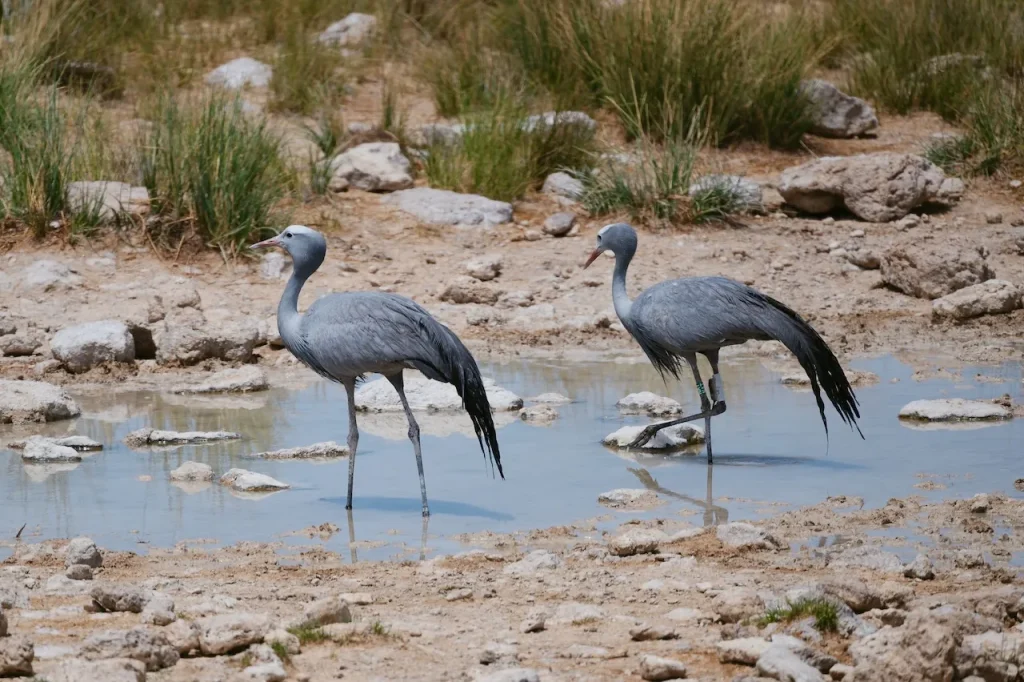
Etosha’s marketing leads with lion, rhino, and elephant. The birding community knows something that the general safari market has been slow to recognise: the park’s 340-plus recorded species, diverse habitats, and the spectacular spectacle of Fischer’s Pan in a flood year make it one of the most productive birding destinations in southern Africa. For a visitor who travels with binoculars as well as a camera, Etosha delivers alongside any destination on the continent.
This guide covers the key species, the best locations, and the seasonal dynamics that determine what you are likely to find. It is not a comprehensive checklist, that requires a dedicated field guide, but it is a practical entry point for visitors who want to use their Etosha time well for birds.
The Habitats
Etosha’s birdlife is distributed across four main habitat types, each with its characteristic species.
Open plains and pan margins: The vast open areas around the Etosha Pan support large ground-dwelling birds: ostrich, kori bustard, Ludwig’s bustard, secretary bird, double-banded courser, and Temminck’s courser. In the dry season these habitats are brown and apparently barren; in the green season they support high grass growth that draws ground-nesting species.
Mopane and acacia bush (western and central): The dominant vegetation type across much of the park. Good for raptors, hornbills, rollers, shrikes, and a range of smaller passerines. The pale chanting goshawk is a conspicuous roadside bird throughout.
Eastern acacia woodland: The denser woodland of the Namutoni section supports a different assemblage: greater honeyguide, black cuckoo shrike, white-crested helmet shrike, and a higher diversity of warblers and flycatchers than the more open western habitats.
Fischer’s Pan and waterhole margins: Waterbird habitat, productive in proportion to the amount of water present. The floodlit waterholes attract nightjars after dark. Fischer’s Pan in a flood year is one of the most spectacular birdwatching experiences in Namibia.
Key Species
Kori Bustard
The kori bustard (Ardeotis kori) is the world’s heaviest flying bird, with large males weighing up to 19kg. It is a conspicuous species of Etosha’s open plains: slow-moving, large, and unmistakable in the field. The male’s lekking display, with inflated white neck plumage and a slow strutting walk, is one of the great bird displays of Africa and most reliably seen in the early months of the year.
Best locations: Open plains near Okaukuejo; pan margins; Gemsbokvlakte area.
Secretary Bird
The secretary bird (Sagittarius serpentarius) is one of Africa’s most distinctive raptors: long-legged, terrestrial, and visually unlike any other bird. It hunts on foot, stamping on snakes and other prey with powerful feet, and is reliably found on the open grasslands of the Okaukuejo and Halali areas in the morning.
Best locations: Open grassland near Okaukuejo; plains between Okaukuejo and Halali.
Lappet-Faced and White-Backed Vultures
Both species are common throughout Etosha and are the most frequently encountered large raptors. Lappet-faced vultures (Torgos tracheliotos) are the dominant species at carcasses, their size and aggressive disposition displacing other vultures; white-backed vultures (Gyps africanus) form the bulk of vulture aggregations at kills.
Following circling or descending vultures is one of the most reliable methods of locating lion kills and large mammal carcasses in the park.
Bateleur Eagle
The bateleur (Terathopius ecaudatus) is one of Etosha’s most reliably encountered raptors and one of its most visually striking: the extremely short tail gives it an unmistakable flight silhouette, rocking from side to side as it soars. It is almost always visible in the sky above Etosha during daylight hours and is commonly seen perched on dead trees near waterholes.
Pale Chanting Goshawk
The pale chanting goshawk (Melierax canorus) is the most frequently seen raptor at ground level, perching conspicuously on roadside acacia trees and telephone poles throughout the park. Its metallic whistling call is a background sound on all Etosha circuits. It hunts lizards and small mammals, often following honey badger on foot to catch prey flushed from the grass.
Fischer’s Pan and Flamingo
Fischer’s Pan adjacent to Namutoni rest camp is the potential highlight of Etosha birding in exceptional years. When the pan holds water, both greater flamingo (Phoenicopterus roseus) and lesser flamingo (Phoeniconaias minor) arrive in large numbers, sometimes in their tens of thousands. The spectacle of a pink horizon of flamingo at dawn, rising from the pan surface and circling in formation before settling again, is one of the most dramatic bird sights in Africa.
The flamingo are not present in every year; water on Fischer’s Pan depends on exceptional rainfall. The green season guide covers the conditions that bring water to the pan and the best timing for flamingo visits.
Other waterbirds at Fischer’s Pan: African spoonbill, various herons and egrets, three-banded plover, kittlitz’s plover, and migrant waders in season.
Martial Eagle
The martial eagle (Polemaetus bellicosus) is one of Africa’s most powerful birds of prey and Etosha is one of the better parks for encountering it. Large, with distinctive spotted underparts, it hunts monitor lizards, mongooses, and even young impala. It is found perched in large trees near waterholes and soaring high over the park.
Ostrich
The common ostrich (Struthio camelus) is impossible to miss in Etosha: the world’s largest bird, standing up to 2.7 metres, is a regular sight on the open plains throughout the park. Adult males in breeding plumage have striking black-and-white markings. The ostrich’s role as prey for lion and cheetah means they are reliably wary on the open plains and their running speed (up to 70km/h) makes them surprisingly difficult for predators to catch.
Hornbills
Three hornbill species are regularly encountered: the yellow-billed hornbill (Tockus leucomelas), red-billed hornbill (Tockus erythrorhynchus), and southern ground hornbill (Bucorvus leadbeateri). The ground hornbill is particularly striking: a turkey-sized terrestrial bird with a red facial wattle, found in small family groups and generally unconcerned by vehicles.
In Damaraland, the Monteiro’s hornbill is the iconic near-endemic species; Etosha does not hold this species but offers the ground hornbill, which Damaraland lacks. The two destinations are genuinely complementary for birders.
Lilac-Breasted Roller
The lilac-breasted roller (Coracias caudatus) is one of Africa’s most photographed birds and one of Etosha’s most conspicuous: electric blue and lilac, perching on roadside branches at eye level, and remarkably tolerant of slow vehicle approach. It is found throughout the park’s acacia habitats.
Seasonal Birding
Dry season (May to October): Resident species are most accessible. Waterhole margins attract waders and waterbirds. Raptors concentrate near waterholes where prey species gather. Fischer’s Pan is dry.
Green season (November to April): Palaearctic migrants arrive, including various warblers, flycatchers, and waders. Nesting activity from resident species. Fischer’s Pan may hold water, with flamingo the potential highlight. Bee-eater species are more common in the green season. Overall species diversity is higher in the green season than the dry.
Birding Logistics
Etosha’s birding is self-drive-accessible throughout. Early morning circuits, before the heat drives species into shade, are the most productive. The waterhole circuit guide covers the roads that are most productive for both mammals and birds.
A good field guide (Newman’s Birds of Southern Africa is standard) and binoculars (8×42 as a minimum for large raptors; 10×42 for distant species on the pan) are the essential additions to standard safari kit. The Etosha packing list includes birding-specific gear.
Contact Mat-Travel to discuss incorporating birding priorities into your Etosha programme.