
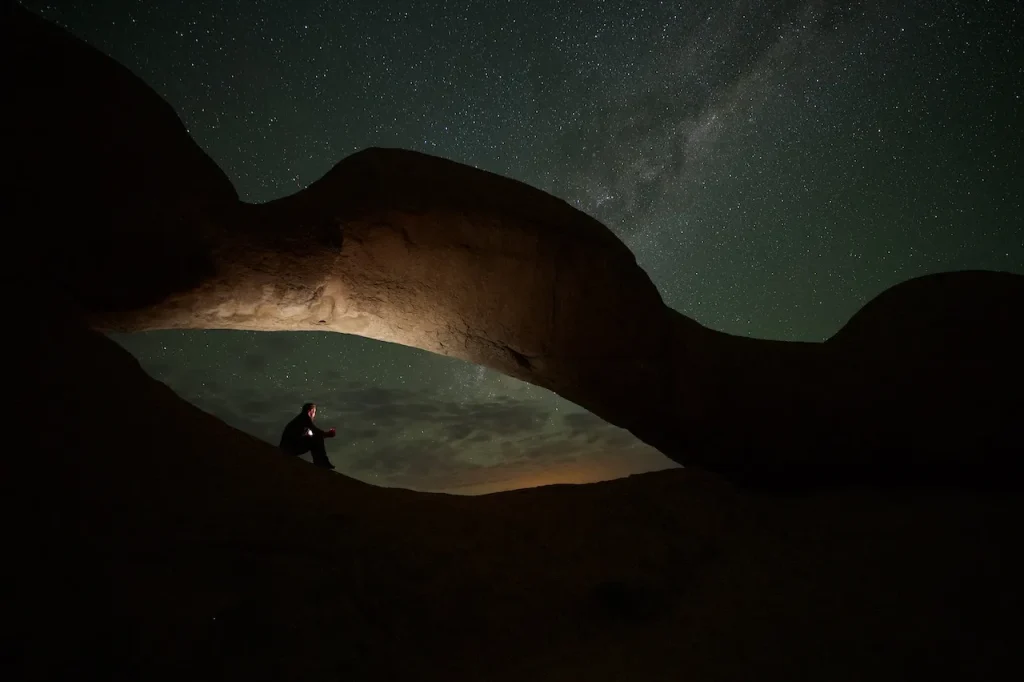
The Milky Way was the first thing I noticed when I turned my headtorch off. Not faint, not suggested, but structural: a dense river of light arcing from horizon to horizon with the granular texture of something three-dimensional rather than projected. The granite domes of Spitzkoppe were visible in the galaxy’s light alone, their pale surfaces glowing against the black, and the boulders immediately around me cast faint shadows.
This is not unusual at Spitzkoppe. It is the default condition on a clear, moonless night. The combination of factors that produce it, extreme distance from urban light sources, dry clear air, high altitude, and the physical forms of the Spitzkoppe granite as ready-made foreground, make this location one of the most consistently productive astrophotography destinations in Africa and the southern hemisphere.
This guide covers everything you need to plan and execute a Spitzkoppe Milky Way shoot: the science, the planning tools, the camera settings, the compositions, and the practical logistics.
Why Spitzkoppe Works for Astrophotography
Light Pollution (or the Lack of It)
Spitzkoppe is located approximately 106 kilometres from Swakopmund and 195 kilometres from Windhoek. On the Bortle dark-sky scale, which runs from 1 (the darkest skies on Earth) to 9 (inner-city light pollution), Spitzkoppe typically measures between 2 and 3 during the dry season: exceptional darkness by any standard. The artificial horizon glow from Swakopmund is faintly visible to the south-west in very clear conditions, but it does not meaningfully affect shooting toward the north, east, or overhead.
Altitude and Atmospheric Clarity
At approximately 1,580 metres above sea level, Spitzkoppe sits above much of the atmospheric moisture and dust that degrades sky transparency at lower elevations. The dry season (May to October) brings exceptionally low humidity, which translates to excellent atmospheric seeing: the stars appear as stable points rather than the shimmering discs produced by moisture-laden air.
The Granite Foreground
The pre-Cambrian granite boulders of Spitzkoppe are pale, smooth-surfaced, and sculptural. In nightscape photography, foreground is everything: the sky is the subject, but the foreground is what transforms a technically competent night sky shot into a compelling image. Spitzkoppe provides extraordinary foreground variety within a small area: individual boulders the size of houses, narrow passages between rock faces, the Arch formation, cliff overhangs, and the distant silhouettes of the main Spitzkoppe peak against the sky.
Planning Your Shoot
The Lunar Calendar
The single most important planning variable for Milky Way photography is the lunar phase. A full moon is bright enough to wash out the Milky Way entirely; even a half moon reduces visibility significantly. For Milky Way photography you need the moon to be either below the horizon during your shooting window or in its new moon phase (less than 10% illumination).
The most productive window at Spitzkoppe is approximately five nights either side of new moon, when the moon is absent from the sky or rises late enough to provide some time for dark-sky shooting before its light affects conditions.
New moon dates fall approximately every 29.5 days; plan your Spitzkoppe nights around them. Astronomical planning apps (PhotoPills, Stellarium, The Photographer’s Ephemeris) allow you to calculate the exact moonrise and moonset times at Spitzkoppe’s coordinates on any date.
Milky Way Visibility
The Milky Way’s galactic core, the densest and most visually spectacular section of the galaxy, is best positioned for southern hemisphere photography from approximately April to September. Within this window, the core is highest above the horizon between 21:00 and 01:00 at Spitzkoppe’s latitude and longitude.
The orientation of the core changes through the season:
- April/May: Core rises in the south-east around 22:00 and is positioned to the south through midnight
- June/July: Core is high in the south by 21:00 and remains well-positioned through midnight; this is the optimal window
- August/September: Core is already high by nightfall but begins to set earlier; shooting window shortens
Planning Apps
PhotoPills is the most complete planning tool for astrophotography. It provides the precise rise, peak, and set times for the galactic core, an AR viewer that shows where the core will appear relative to your physical position at any given time, and a night mode that preserves dark adaptation. Enter Spitzkoppe’s coordinates (21°49’S, 15°11’E) and the date of your shoot and PhotoPills will show you exactly where to stand and which direction to face for the core composition you want.
Stellarium (free, web and app) provides an excellent sky map showing all sky objects, constellation lines, and atmospheric conditions. Less practical for field AR use than PhotoPills but excellent for pre-trip desktop planning.
Camera Settings: Starting Points
These are starting points, not fixed formulas. Every camera sensor handles high ISO differently, and every lens has different transmission characteristics at maximum aperture. Bracket these settings and review your results in the field to find what your specific system produces.
The Basic Milky Way Exposure
| Setting | Starting Value |
|---|---|
| ISO | 3200 |
| Aperture | f/2.8 (widest available) |
| Shutter speed | See 500 rule below |
| White balance | 3800 to 4200K (tungsten/incandescent range gives warmer stars) |
| Focus | Manual; set to infinity during daylight, verify on a bright star at night |
The 500 Rule: To find the maximum shutter speed before stars begin to trail visibly, divide 500 by your focal length in millimetres. At 20mm, the maximum shutter before trailing is 25 seconds. At 14mm, it is 35 seconds. On a full-frame camera; multiply by 1.5 for APS-C sensors. For a sharper result, use the more conservative 400 rule.
High ISO behaviour: Test your specific camera body before the trip. Shoot at ISO 3200, 6400, and 12800 at home and compare the noise at 100% on your processing screen. Modern full-frame sensors from Sony, Nikon, and Canon perform well to ISO 6400 with good noise reduction workflow; smaller sensors show more noise at the same ISO.
Foreground Illumination
The granite boulders at Spitzkoppe are pale enough that they reflect sufficient galactic and ambient light to register in a long exposure at ISO 3200 to 6400. However, you have options for supplementary illumination:
Light painting: A single pulse of a small LED torch during the exposure, directed at a foreground boulder, adds localised warm light that gives the foreground a three-dimensional quality. Practise the technique before the shoot; it requires timing and consistency.
Blue hour composition: The 30 to 40 minutes immediately after sunset provides a deep blue sky with the first bright stars visible. A bracketed exposure combining a longer foreground exposure (taken during blue hour) with a sky exposure (taken during full darkness) and blended in post-processing gives the most detailed, lowest-noise final image. This is a more involved technique but produces superior results to a single all-dark exposure.
Composition at Spitzkoppe
The Arch
The most celebrated astrophotography composition at Spitzkoppe. A natural granite arch spans a gap between two boulder formations, and positioning the camera inside the arch to frame the Milky Way through the opening produces one of the most iconic nightscape images available at the location.
Reach the Arch from the campsite in approximately 20 minutes of walking in daylight; scout the exact camera position and note it for your night shoot. The arch opening frames a section of sky corresponding to roughly the southern to south-eastern quadrant, which aligns well with the galactic core position from June to August.
Composition notes: A very wide angle (14 to 17mm on full frame) is needed to include the arch frame and a significant portion of the Milky Way above it. Position the camera low inside the arch for maximum negative space in the upper portion of the frame.
Boulder Fields Around the Campsite
The camping area itself provides the most varied and most accessible compositions. Boulders the size of small houses, stacked and leaning against each other in geometrically complex arrangements, create an almost infinite variety of foreground options within a few minutes’ walk of your tent.
Look for:
- Boulders with a naturally flat top that can be silhouetted against the core of the Milky Way
- Narrow passages between boulder faces that frame a strip of sky
- Overhanging faces that create a cave-like bottom of frame with open sky above
- A single large boulder in the left or right third of the frame with the core occupying the opposite sky
The Main Spitzkoppe Peak
From a position approximately 500 to 800 metres south-east of the main peak, the summit silhouette against the Milky Way provides a powerful compositional anchor. The peak is tall and sharp enough to read clearly as a silhouette even on a bright star-filled night. A telephoto (85 to 135mm) compresses the peak and galaxy into a single frame; a wide angle (20 to 24mm) includes more foreground and sky context.
Dark Adaptation and Practical Night Logistics
Dark adaptation, the process by which the human eye becomes sensitive to low light levels, takes approximately 20 to 30 minutes after leaving a brightly lit environment. Any exposure to white light resets the process. For shooting, this means:
- Turn off all white lights on arrival at your shooting location
- Use a red-filtered headtorch for navigation and equipment adjustments (red light does not reset dark adaptation)
- Review camera images with the screen at its lowest brightness setting
- Avoid looking at the campfire or lodge lights during your shooting window
Temperature
Clear, moonless nights at Spitzkoppe in the dry season can be cold, with temperatures dropping to 5 to 10°C after midnight in June and July. Bring a warm layer regardless of how warm the day was. Cold fingers and camera controls do not mix well.
Wildlife
Spitzkoppe is unfenced wilderness. Nocturnal wildlife, including porcupine, springhare, and occasional nocturnal predators, is active after dark. Walk with a torch and make noise when moving between boulders. Nothing about this is alarming; it simply requires awareness.
Post-Processing
A complete post-processing workflow is beyond the scope of this guide, but the key steps for a single-exposure Milky Way image in Adobe Lightroom or equivalent are:
- Reduce noise (luminance 30 to 60; chrominance 20 to 40, depending on ISO used)
- Increase clarity on the Milky Way structure
- Use the radial filter to enhance the galactic core region selectively
- Lift shadows in the foreground to recover detail without clipping highlights in the sky
- Increase colour vibrance to bring out the hydrogen-alpha reds and blues in the nebulae within the core
For stacking (combining multiple exposures to reduce noise and increase detail), Sequator (Windows, free) and Starry Landscape Stacker (Mac) are accessible tools for photographers newer to the technique.
Combining Spitzkoppe with a Damaraland Itinerary
Spitzkoppe sits at the southern gateway to Damaraland, making it a natural starting or ending point for a wider circuit. Arriving from the coast (Swakopmund or Walvis Bay), two nights at Spitzkoppe for astrophotography before driving north into Damaraland is an excellent opening sequence. The Damaraland self-drive guide covers the routing north from Spitzkoppe, and the Damaraland itineraries show how to build astrophotography nights at Spitzkoppe into a complete programme.
Contact Mat-Travel to plan a photography-focused Damaraland itinerary.