
Twyfelfontein: Der definitive Besucherleitfaden zu Namibias UNESCO-Felskunststätte
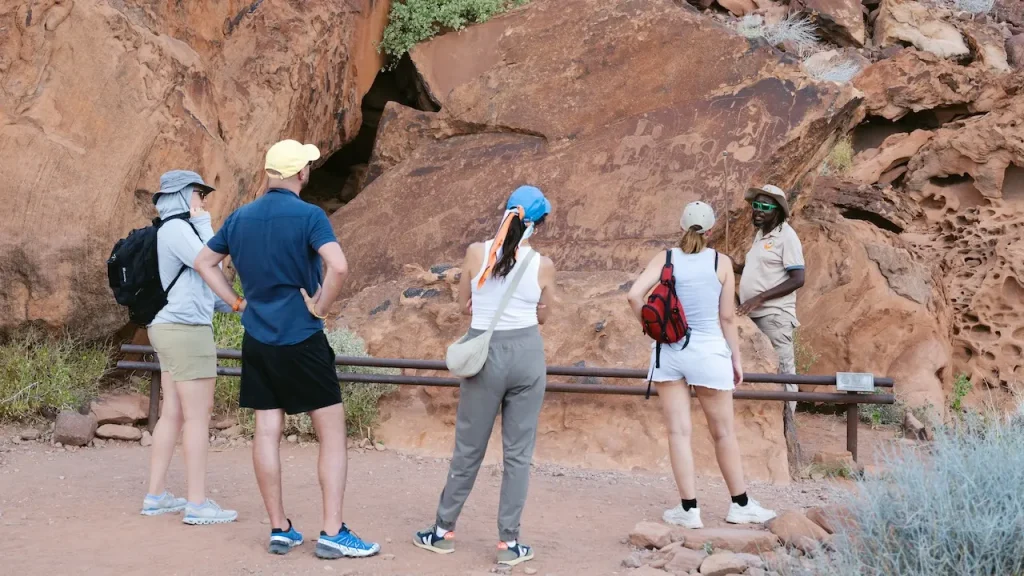
The valley doesn’t look like much from the road. A dry watercourse, a cluster of sandstone outcrops bleached pale by the sun, low thorn scrub pressing in from the sides. Then you step closer to the rock face and your eyes begin to adjust, and suddenly they are everywhere: lion paw prints the size of dinner plates, rhino carved with extraordinary precision, giraffe stretching their necks up smooth orange sandstone, elephant footprints pressed into the rock by a hand that has been dust for two thousand years.
Twyfelfontein is Africa’s greatest concentration of San rock engravings. Over 2,500 individual images cover the sandstone outcrops of a single Damaraland valley, the accumulated work of hunter-gatherer communities across a period spanning at least two millennia. In 2007 it became Namibia’s first and only UNESCO World Heritage Site, recognition for a place that had been largely unknown outside Namibia until the 1960s.
Dies ist der definitive Leitfaden für einen Besuch in Twyfelfontein: die Felsgravuren selbst, der kulturelle Kontext, die logistischen Aspekte und wie man das Erlebnis optimal nutzt.
Schnelle Fakten
| UNESCO status | Welterbestätte (eingetragen 2007) |
| Standort | Uibasen-Twyfelfontein Conservancy, Zentral Damaraland |
| Anzahl der Felsgravuren | Über 2.500 einzelne Darstellungen |
| Alter | Geschwätze 2.000 bis 6,000 Jahre alt |
| Geführte Touren | Obligatorisch; vor Ort verfügbar |
| Dauer | The main walk takes about 1 hour |
| Eintritt | NAD 270 per adult 8-17 yrs NAD 220 (Price for international visitors) |
| Beste Besuchszeit | Früher Morgen oder später Nachmittag für streifendes Licht |
| Nächste Unterkunft | Mowani Mountain Camp, Camp Kipwe, Twyfelfontein Country Lodge |
| Nächster Campingplatz | Aba-Huab Community Campingplatz |
| Koordinaten | 20°35’S, 14°22’E |
Die Felsgravuren verstehen
Wer hat sie geschaffen?
The engravings at Twyfelfontein were made by San hunter-gatherers, the indigenous people who inhabited southern Africa for tens of thousands of years before the arrival of Bantu-speaking farmers and, later, European settlers. The San lived in this valley intermittently over a period of at least 2,000 years, returning to a spring at the base of the sandstone outcrop that provided reliable water in an otherwise arid landscape. It is from this spring that the site takes its name: “Twyfelfontein” is Afrikaans for “doubtful spring”, a name given by a European settler in the 1940s who was uncertain the spring could be relied upon year-round.
Die Technik
Die Gravuren wurden dadurch geschaffen, dass die dunkle Wüstenlackschicht entfernt wurde, eine dünne oxidierte Schicht aus Mangan und Eisen, die sich in ariden Umgebungen auf freiliegenden Felsoberflächen bildet, um den helleren Sandstein darunter freizulegen. Als Werkzeug diente höchstwahrscheinlich eine scharfe Quarzitspitze, und die Technik erforderte Geduld und Präzision: Die Bilder wurden nicht geritzt, sondern gepickt, also durch wiederholte kleine Schläge geformt, die nach und nach die Umrisse eines Tieres oder eines Fußabdrucks in sorgfältigem Relief entstehen lassen.
The quality is remarkable by any standard. Animals are depicted in accurate profile, with anatomically correct proportions and distinctive species characteristics, specifically the ear shape of a rhinoceros, the pattern of a giraffe’s neck, the paws of a lion. This is not the naive mark-making of a bored hand but purposeful, skilled work.
Was bedeuten sie?
Dies ist die Frage, die sich jeder Besucher stellt, und die ehrliche Antwort lautet, dass eine eindeutige Gewissheit nicht möglich ist. Die Gravuren wurden von Gemeinschaften geschaffen, die keine schriftlichen Aufzeichnungen hinterlassen haben und deren Nachfahren, soweit sie heute noch existieren, die direkte Tradition der Deutung weitgehend verloren haben.
Die vorherrschende akademische Interpretation, die auf vergleichender ethnografischer Forschung im gesamten südlichen Afrika basiert, sieht viele Felsbilder im Zusammenhang mit schamanischen Praktiken der San. Die San glaubten, dass bestimmte Personen durch Trancezustände, ausgelöst durch rhythmischen Tanz und Hyperventilation, in eine Geisterwelt eintreten und dort mit übernatürlichen Kräften in Kontakt treten konnten, die Regen, Fruchtbarkeit und die Bewegungen von Tieren beeinflussten. Die Bilder könnten das darstellen, was in solchen Trancezuständen gesehen oder erlebt wurde, und eher eine Art Karte oder Erinnerung spiritueller Erfahrungen sein als eine wörtliche Darstellung der in der Landschaft beobachteten Tiere.
Dies erklärt einige ansonsten schwer verständliche Merkmale: Tiere, die mit menschlichen Eigenschaften dargestellt sind, menschliche und tierische Fußspuren, die in scheinbar bedeutungsvollen Kombinationen miteinander verwoben sind, sowie der Löwe, der in Twyfelfontein häufiger erscheint, als es seiner tatsächlichen Häufigkeit in der Landschaft entsprechen würde, da der Löwe in vielen San-Gruppen ein starkes schamanisches Symbol war.
What the engravings are not, almost certainly, is a hunting record or a map of game trails, though these interpretations were proposed early in the site’s academic history.
Wichtige Felsbilder, auf die man achten sollte
Ihr Guide führt Sie durch die Anlage und weist auf die wichtigsten Highlights hin, aber die folgenden Felsbilder sollten Sie gezielt suchen:
Der Löwenmensch: Das bekannteste und am meisten diskutierte Bild in Twyfelfontein. Eine große Raubkatze, als Löwe durch Größe und Haltung identifiziert, zeigt Pfoten, die nicht als Krallen, sondern als abgerundete, menschenähnliche Füße dargestellt sind. Dieses Motiv wird häufig im Zusammenhang mit schamanischer Verwandlung diskutiert, bei der der Schamane während der Trance tierische Eigenschaften annimmt.
Das Fußspuren-Panel: Eine dichte Konzentration von Tier- und menschlichen Fußabdrücken verschiedener Arten, eng beieinander angeordnet, was eher auf eine absichtliche Komposition als auf eine zufällige Ansammlung hindeutet.
Der Elefant mit ungewöhnlich langem Schwanz: Eines der am häufigsten fotografierten Motive der Stätte: ein großer Elefant, dessen Schwanz auf eine unwahrscheinliche Länge verlängert wurde, mit einer Giraffe am Ende des Schwanzes, was auf eine bewusste visuelle Verbindung zwischen den beiden Tieren hindeutet.
Die Nashorn-Fries: Ein langes Panel mit mehreren Nashorn-Darstellungen, bemerkenswert für die Genauigkeit der Hornform und der Ohrposition, die eine sichere Bestimmung der Art ermöglicht.
Was Sie bei Ihrem Besuch erwartet
Geführte Touren
Der Zugang zur Felsgravuren-Stätte selbst ist ausschließlich in Begleitung eines Guides der Uibasen-Twyfelfontein Conservancy erlaubt. Dies ist Bestandteil des UNESCO-Managementplans für die Stätte und wird entsprechend durchgesetzt. Guides sind ab Öffnung des Besucherzentrums (08:00 Uhr) vor Ort verfügbar, und Touren starten regelmäßig über den Tag verteilt. Private Guides können im Voraus über die unten aufgeführten Lodges arrangiert werden.
Die Pflicht, einen Guide zu nutzen, ist nicht nur administrativer Natur. Die Guides in Twyfelfontein sind Mitglieder der lokalen Gemeinschaft, die die Stätte sehr gut kennen und Besucher gezielt zu leicht übersehbaren Gravuren führen können, kulturellen Kontext vermitteln und sicherstellen, dass der Ort mit dem nötigen Respekt behandelt wird. Ein guter Guide verwandelt ein potenziell verwirrendes Klettern über Felsen in ein zusammenhängendes und eindrucksvolles Erlebnis.
Der Rundweg
The main guided route covers the principal engraving panels via a path of approximately 500 metres, with some uneven terrain and boulder scrambling required. The walking is not difficult, but closed shoes are essential and the rocks become very hot by mid-morning in warm months. Allow 60 minutes for a standard guided tour; dedicated enthusiasts may want to arrange an extended tour of 2.5 hours that covers additional panels on the outer circuit.
Tageszeit und Licht
Die wichtigste praktische Entscheidung für Ihren Besuch in Twyfelfontein ist die Wahl der Tageszeit. Die Gravuren entstehen durch das Entfernen der dunklen Wüstenlackschicht, wodurch der hellere Fels darunter sichtbar wird. Dadurch sind sie am besten erkennbar, wenn das Licht in einem flachen Winkel über die Oberfläche streicht und Schatten in den eingemeißelten Linien erzeugt. Das mittägliche Licht, das senkrecht auf die horizontale Oberfläche fällt, lässt die Gravuren nahezu verschwinden und macht sie schwer lesbar. Früher Morgen und später Nachmittag sind daher ideal. Der Fotografie-Leitfaden beschreibt die optimale Zeitplanung und Techniken zur bestmöglichen Darstellung der Gravuren.
Die Stätte öffnet um 08:00 Uhr und schließt um 17:00 Uhr. Eine Ankunft zur Öffnungszeit bietet das beste Licht und die geringste Besucherzahl.
Besucherzahlen und Andrang
Twyfelfontein is the most visited site in Damaraland, which means it can feel busy relative to the wilderness solitude of the rest of the region. Peak season (June to September) brings the highest visitor numbers. Even then, it is rarely what would be considered crowded by international heritage site standards, but if complete solitude is important to you, the early morning opening is again the best strategy.
Kombination von Twyfelfontein mit der Halbtagestour
Die Organ Pipes und der Burnt Mountain liegen nur etwa zehn Fahrminuten von Twyfelfontein entfernt und bilden zusammen den natürlichen Ergänzungsteil eines jeden Besuchs. Die logische Reihenfolge ist, bei Sonnenaufgang an den Organ Pipes anzukommen, um das beste Licht auf den Basaltsäulen zu nutzen, anschließend zum Burnt Mountain weiterzufahren, um die außergewöhnlichen vulkanischen Farben zu sehen, und danach zur Hauptführung in Twyfelfontein gegen Vormittag aufzubrechen. Der detaillierte Loop-Guide beschreibt Zeitplanung und Fahrstrecken.
Die Aba-Huab-Flussstrecke ist über denselben Straßenknotenpunkt erreichbar und bietet die Möglichkeit, im trockenen Flussbett Wüstenelefanten zu beobachten, besonders am späten Nachmittag nach dem Besuch der Felsgravuren.
Kultureller Kontext: Die Damara
Die San, die die Gravuren geschaffen haben, leben heute nicht mehr im Twyfelfontein-Tal. Die Landschaft wird heute von den Damara bewohnt, einer eigenständigen Volksgruppe mit einer eigenen, tiefen historischen Verbindung zu dieser Region. Die Uibasen-Twyfelfontein Conservancy ist eine gemeinschaftliche Institution der Damara, und die Guides sowie das Personal vor Ort stammen aus dieser Gemeinschaft. Das Damara Living Museum, nur wenige Kilometer von der Felsgravuren-Stätte entfernt, bietet eine ergänzende kulturelle Erfahrung mit Fokus auf Damara-Traditionen statt auf das San-Erbe.
Das Verständnis der Unterscheidung zwischen diesen beiden Gruppen sowie der komplexen Menschheitsgeschichte Damaralands verleiht einem Besuch in Twyfelfontein zusätzliche Tiefe. Der Leitfaden zur San-Felskunst beleuchtet den weiteren kulturellen und spirituellen Kontext der Gravuren in der gesamten Region.
Anreise
Twyfelfontein is accessible via a gravel road off the C39, approximately 25 kilometres west of Khorixas. The turn-off is signposted and the road is in reasonable condition, passable by standard 4×4 and, in good conditions, by careful 2WD vehicles. Allow 45 minutes from Khorixas. The drive from Kamanjab via the C35 and C39 takes approximately two hours.
Vollständige Fahranweisungen, Hinweise zum Straßenzustand sowie Routen ab Windhoek sind im Selbstfahrer-Leitfaden und im Leitfaden Windhoek nach Damaraland beschrieben.
Unterkünfte
In der Nähe von Twyfelfontein
Mowani Mountain Camp ist die spektakulärste Option in unmittelbarer Umgebung: eine Luxuslodge, die zwischen und auf riesigen Felsblöcken erbaut wurde und erhöhte Ausblicke über das Aba-Huab-Tal bietet. Die Nähe zur Stätte ermöglicht Besuche am frühen Morgen, bevor die Tagesausflügler eintreffen. Alle Details finden Sie im Lodge-Leitfaden.
Camp Kipwe ist eine kleinere, intimere Unterkunft, die ebenso nahe an den Felsgravuren liegt und eine sehr persönliche Atmosphäre sowie exzellente lokale Guides bietet.
Twyfelfontein Country Lodge ist eine komfortable Mittelklasse-Option direkt neben der Stätte und bietet ein gutes Preis-Leistungs-Verhältnis für Reisende, die Lage über Stil priorisieren.
Camping
Aba-Huab Community Campsite ist ein von der Gemeinschaft geführter Campingplatz am Aba-Huab-Fluss, nur eine kurze Fahrt von der Felsgravuren-Stätte entfernt. Einfache Einrichtungen, aber eine wunderschöne Lage, mit der Möglichkeit, Elefanten im Flussbett bei Sonnenaufgang und Sonnenuntergang zu sehen. Details finden Sie im Campingplatz-Leitfaden.
Praktische Tipps
- Tragen Sie geschlossene Schuhe mit gutem Profil. Die Felsoberflächen sind uneben und werden extrem heiß.
- Wear closed shoes with good grip. The rock surfaces are uneven and become extremely hot.
- Photography at the site is permitted, but no flash and no touching of any engraving surfaces. The oils from human hands accelerate the degradation of the desert varnish.
- Das Besucherzentrum verfügt über gute Ausstellungen in Englisch und Deutsch, die es wert sind, vor der Führung etwa 15 Minuten zu verbringen, da sie den Kontext vermitteln und das Gesehene deutlich bereichern.
- Die Eintrittsgebühr der Conservancy ist getrennt von allen Lodge-Aktivitätsgebühren zu bezahlen. Führen Sie Bargeld in namibischen Dollar mit sich.
Twyfelfontein in Ihre Damaraland-Reiseroute einbauen
Twyfelfontein liegt zentral in einer Damaraland-Reiseroute und ist gut erreichbar von Vingerklip, dem Versteinerten Wald, dem Brandberg sowie Khorixas als Versorgungsbasis. Unsere 3-, 5- und 7-tägigen Damaraland-Reiserouten integrieren Twyfelfontein jeweils als zentralen Bestandteil. Sprechen Sie mit dem Mat-Travel Team, um es in Ihre individuelle Reiseplanung einzubauen.
NWR-Campingplatzreservierungen und Fahrzeugvermietung bis hin zu Aufenthalten in privaten Lodges im NamibRand sowie geführten Dünen-Fotografieprogrammen.