
Die wüstenadaptierten Elefanten des Huab-Flusses: Was macht sie so besonders?
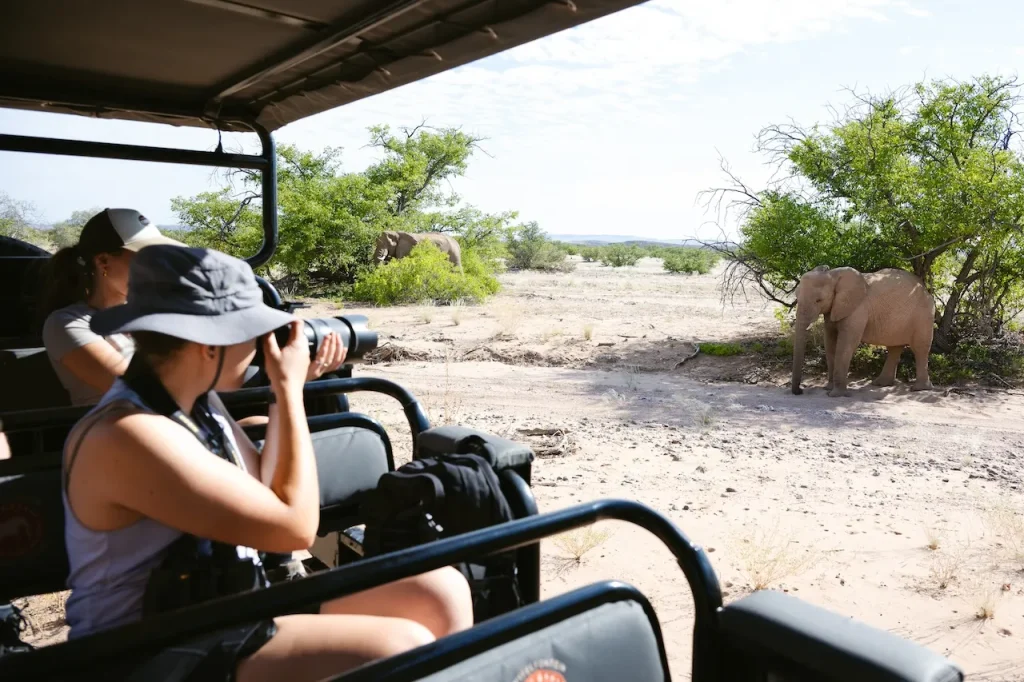
Das Erste, was man bemerkt, ist die Stille. Der Huab-Fluss, ein breites Band aus weißem Sand, das sich durch zerklüftete Vulkanhügel schneidet, erscheint völlig leer. Dann deutet Ihr Reiseleiter auf einen grauen Fleck am anderen Ufer, und während sich Ihre Augen anpassen, materialisiert sich eine ganze Herde: zwanzig, vielleicht dreißig Elefanten, die sich mit außergewöhnlicher Langsamkeit durch das trockene Flussbett bewegen. Kein Plantschen, kein Trompeten. Nur riesige graue Gestalten in einer blassen Wüstenlandschaft, die sich an einem Ort, der eigentlich kein Leben beherbergen dürfte, vollkommen zu Hause fühlen.
Die wüstenadaptierten Elefanten des Damaralandes gehören zu den bemerkenswertesten Populationen von Großsäugern auf der Erde. Sie sind biologisch gesehen keine eigene Art oder Unterart, sondern identisch mit dem afrikanischen Steppenelefanten (Loxodonta africana), der auf dem gesamten Kontinent vorkommt. Doch das Leben in extremer Trockenheit über Generationen hinweg hat sie grundlegend geprägt: in ihrem Verhalten, ihrer Physiologie und in ihrer Beziehung zu der Landschaft, die sie bewohnen. Ihnen in ihrer Wüstenheimat zu begegnen, ist eine der prägendsten Erfahrungen jeder Damaraland-Reise.
What Makes Damaraland’s Elephants Different?
Sie legen enorme Strecken zurück.
Savanna elephants in well-watered environments typically move within home ranges of 50–100km². Damaraland’s desert elephants have been tracked moving up to 700km in a single seasonal circuit, following ancient migration routes between water sources that their grandmothers’ grandmothers first established. This is learned knowledge, passed matriarch to matriarch across generations: where to dig for subsurface water in a dry riverbed, which kopje collects morning dew, which ephemeral pan holds water after rain.
Ihre Körper haben sich angepasst
Researchers have documented several physical differences in Damaraland’s elephants compared to their savanna counterparts. Their legs are longer relative to body size, an adaptation that may help with heat dissipation and with covering greater distances efficiently. Their feet are broader, better suited to navigating soft sand and rocky ground. Their body condition is typically leaner, carrying less fat reserve because the caloric demands of constant movement in heat are extraordinary.
They Drink Far Less Frequently
Savanna elephants drink every 24–48 hours. Desert-adapted individuals have been recorded going four to five days without drinking, extracting moisture instead from the succulent plants, !nara melon, tsamma, and various succulents, that form part of their diet. When they do find water, a single adult can drink up to 200 litres in a session.
Sie graben nach Wasser
One of the most remarkable behaviours of Damaraland’s elephants is their ability to excavate subsurface water from apparently dry riverbeds. Using feet and tusks, they dig down to the water table in locations that appear bone dry on the surface. These excavations are then used by other wildlife, oryx, zebra, and birds all benefit from holes dug by elephants. In the desert ecosystem, the elephant is a keystone species in the most literal sense: without them, many other animals couldn’t survive.
Sie sind leiser
Observers consistently note that Damaraland’s elephants move and behave with unusual quietness compared to their counterparts in places like Etosha or Chobe. The social dynamics are the same, matriarch-led family units, adolescent males breaking away from family groups, musth bulls ranging widely, but the vocalisation, the splashing, the boisterous behaviour that characterises elephants at a permanent waterhole, is largely absent. These are animals conserving energy.
Wo man sie findet: Wichtige Standorte
Der Huab-Fluss (Hauptkorridor)
Das Huab-Flusssystem ist der wichtigste Elefantenkorridor im zentralen Damaraland. Herden, die in der Trockenzeit mitunter 30 bis 50 Tiere umfassen, ziehen entlang des Huab und seiner Nebenflüsse zwischen dem Hochland und dem Hinterland der Skelettküste. Das weiße Sandbett des Flusses bietet einen außergewöhnlichen fotografischen Kontrast zum grauen Fell der Elefanten, besonders im goldenen Licht der späten Nachmittagsstunde. In unserem Fotografie-Leitfaden für Wüstenelefanten finden Sie Tipps zu Timing und Technik.
Der beste Ausgangspunkt für Elefantenbeobachtungen am Huab-Fluss ist das Damaraland Camp (Wilderness Safaris). Dort werden in Zusammenarbeit mit dem Naturschutzgebiet Doro !Nawas geführte Pirschfahrten und Wanderungen entlang des Flusses angeboten. Das Doro !Nawas Camp ist eine weitere hervorragende Option mit etwas anderen Zugangswegen und einem starken Fokus auf die lokale Bevölkerung.
Der Aba-Huab Fluss
Der Aba-Huab verläuft durch das Tal von Twyfelfontein und beherbergt ganzjährig eine ansässige Elefantenpopulation. Dieses Gebiet ist gut für Selbstfahrer zugänglich. Die Trockenflussbett-Piste ab der Kreuzung mit der C39 bietet besonders am frühen Morgen und späten Nachmittag hervorragende Möglichkeiten zur Elefantenbeobachtung. Die Elefanten des Aba-Huab gehören zu den zuverlässigsten Sichtungen in Damaraland und machen dieses Gebiet zu einer ausgezeichneten Wahl für Besucher ohne lodgebasierten Guide. In Kombination mit den Felsgravuren von Twyfelfontein sowie der Rundfahrt zu den Orgelpfeifen und dem Burnt Mountain ergibt der Aba-Huab einen abwechslungsreichen und lohnenden Tagesausflug.
Der Hoanib-Fluss (nördliche Grenze)
Der Hoanib-Fluss bildet die nördliche Grenze zwischen Damaraland und Kaokoland. Dies ist der abgelegenste und am wenigsten besuchte Elefantenlebensraum der Region, Heimat sowohl der Wüstenelefanten als auch der Wüstenlöwen, und hauptsächlich im Rahmen geführter Fly-in-Reisen zugänglich. Tierbeobachtungen in diesem Gebiet wirken besonders intensiv und ursprünglich, da man hier meist keinerlei anderen Besuchern begegnet.
Naturschutz: Eine Erfolgsgeschichte der Erholung
Die Elefantenpopulation Damaralands schrumpfte in den 1980er-Jahren auf weniger als 30 Tiere, nachdem jahrzehntelange Wilderei wegen Elfenbein sowie Konflikte mit landwirtschaftlichen Gemeinschaften schwere Auswirkungen hatten. Heute hat sich der Bestand auf etwa 600 bis 700 Tiere erholt. Diese bemerkenswerte Entwicklung ist nahezu vollständig dem namibischen Community-Conservancy-Modell zuzuschreiben.
Die Grundidee dieses Modells ist auf elegante Weise einfach: Wenn Gemeinschaften Einkommen durch lebende Elefanten erzielen, sei es durch Arbeitsplätze in Lodges, Einnahmen aus Conservancy-Managementgebühren oder direkt durch den Tourismus, entsteht ein unmittelbarer Anreiz, diese Tiere zu schützen. Die Wilderei geht zurück. Mensch-Wildtier-Konflikte werden gemanagt, anstatt die Tiere zu töten. Dadurch können sich die Elefanten frei über kommunales Land bewegen, weil die Gemeinschaften ihre Anwesenheit ausdrücklich wünschen.
Die Torra Conservancy und die Doro !Nawas Conservancy, die gemeinsam den wichtigsten Korridor des Huab-Flusses abdecken, gehören zu den stärksten praktischen Beispielen dieses Modells. Wer eine Lodge innerhalb dieser Conservancies wählt und die entsprechenden Conservancy-Gebühren bezahlt, trägt mit seinem Besuch direkt zum Schutz und Erhalt dieser Gebiete bei.
Wie man ihnen verantwortungsvoll begegnet
Nutzen Sie einen erfahrenen und seriösen Guide
The best elephant encounters in Damaraland happen with guides who understand the animals’ behaviour and know the individuals. Lodge guides in the Huab corridor know many of the matriarchs by sight and can predict behaviour accordingly. This is not just about safety, it is about quality of experience. An experienced guide will position the vehicle in the right place at the right moment for extraordinary sightings.
Distanz und Verhalten
Die allgemeine Richtlinie für Begegnungen mit Wüstenelefanten liegt bei einem Mindestabstand von 50 Metern im Fahrzeug. Wüstenelefanten sind nicht so stark an Fahrzeuge gewöhnt wie die Elefanten in Etosha, und ihnen ausreichend Raum zu geben ist sowohl respektvoll als auch praktisch wichtig, denn ein gestresster Elefant in der Wüste ist unberechenbar. Zeigt ein Tier Anzeichen von Unruhe oder Stress, etwa erhobenen Kopf, abgespreizte Ohren oder Scheinangriffe, wird Ihr Guide das Fahrzeug umgehend zurückziehen.
Zu Fuß, was einige Lodge-geführte Erlebnisse unter geeigneten Bedingungen anbieten, werden die Abstandsregeln strikt vom Guide kontrolliert. Versuchen Sie niemals, sich Elefanten ohne einen erfahrenen Guide zu Fuß zu nähern.
Don’t Block Movement
Wüstenangepasste Elefanten folgen uralten Wanderrouten. Wenn sich eine Herde durch ein Flussbett bewegt, widerstehen Sie der Versuchung, Ihr Fahrzeug quer in ihren Weg zu stellen. Lassen Sie die Tiere passieren. Das Erlebnis, eine Herde ruhig an sich vorbeiziehen zu sehen, ist weitaus eindrucksvoller, als eine nähere Begegnung zu erzwingen, indem man ihren Weg blockiert.
Fotografie
Der helle Sand des Huab stellt Kameras vor schwierige Belichtungsbedingungen. Häufig werden entweder die Elefanten zu dunkel dargestellt oder der Sand überbelichtet, beziehungsweise umgekehrt. In unserem ausführlichen Fotografie-Guide für Wüstenelefanten finden Sie praktische Lösungen dafür. Das späte Nachmittagslicht, etwa ab 16:00 Uhr, färbt den Sand orange und taucht die Elefanten_
Die Kombination der Elefanten mit einer größeren Reiseroute
Begegnungen mit Wüstenelefanten lassen sich hervorragend mit Black-Rhino-Tracking in der Palmwag-Konzession im Nordwesten kombinieren sowie mit Twyfelfontein als kulturellem Gegenpol zum Fokus auf Wildtiere. Unsere Übersicht zur Tierwelt Damaralands zeigt, welche Rolle der Elefant im größeren Ökosystem spielt, gemeinsam mit dem Wüstenlöwen, dem Spitzmaulnashorn und dem Hartmann-Bergzebra.
The same desert-adapted elephant population ranges west into the Hoarusib River corridor on the Skeleton Coast and north through the Kaokoland river systems, making this one of the most wide-ranging elephant populations in southern Africa.
Sowohl unsere 5-tägigen als auch 7-tägigen Damaraland-Routen beinhalten gezielt eingeplante Zeit im Huab-Flusskorridor und sind so aufgebaut, dass die Chancen auf Elefantensichtungen максимально erhöht werden.
Planen Sie Ihr Wüstenelefanten-Erlebnis
Die Huab-Fluss-Elefanten sind eine Begegnung, die neu definiert, was ein Wildtiererlebnis sein kann. Keine Zäune, keine Menschenmengen, keine Garantie, nur eine uralte Herde in einer uralten Landschaft, die nach Regeln lebt, die über Jahrtausende entstanden sind.
Unser Team bei Mat-Travel kann alles organisieren, von einer einzelnen Nacht im Damaraland Camp bis hin zu einer umfassenden Nordwest-Rundreise, die Elefanten, Nashörner, Felskunst und die Skeleton Coast-Wildnis miteinander verbindet. Kontaktieren Sie uns, um mit der Planung zu beginnen.
NWR-Campingplatzreservierungen und Fahrzeugvermietung bis hin zu Aufenthalten in privaten Lodges im NamibRand sowie geführten Dünen-Fotografieprogrammen.