
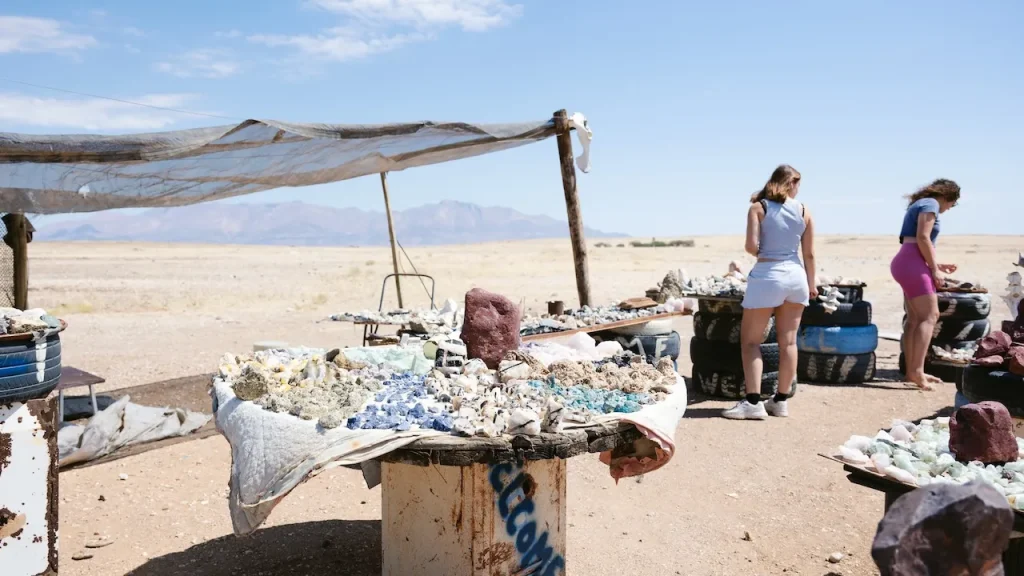
Der Kunsthandwerksmarkt am Versteinerten Wald ist leicht zu übersehen. Er befindet sich am Eingang des Geländes, in einer Reihe kleiner Stände unter einer Planenüberdachung, und seine Lage im touristischen Rundkurs lässt ihn wie jeden anderen Souvenirmarkt an Touristenorten in Afrika wirken. Man sollte jedoch innehalten und genauer hinsehen. Die Frau am nächsten Tisch verkauft Schmuck aus Straußeneierschalenperlen, die sie selbst gebohrt und aufgefädelt hat. Dieser Prozess dauert pro Stück mehrere Stunden. Der Preis, den sie verlangt, ist moderat. Die Alternative, ein vergleichbares Objekt in einem Souvenirgeschäft in Windhoek zu kaufen, generiert kein Einkommen für die Menschen der Gemeinschaft, auf deren Land man sich befindet.
Die Kunsthandwerksmärkte in Damaraland sind echte gemeinschaftsbasierte Unternehmungen, und die Wahl, wo und von wem man kauft, hat direkte Auswirkungen auf die Menschen, die davon profitieren.
Was macht ein Kunsthandwerk authentisch?
Im Kontext Damaralands bedeutet authentisch, dass ein Objekt von Hand von einem Mitglied der Gemeinschaft unter Verwendung traditioneller Materialien oder Fertigkeiten hergestellt wurde. Dies bedeutet nicht zwingend, dass es identisch mit vorkolonialen Praktiken ist; Handwerkstraditionen entwickeln sich weiter, und zeitgenössische Damara-Kunsthandwerker integrieren neue Materialien und Techniken, während sie die Fertigkeiten und den kulturellen Kontext bewahren, die dem Werk seinen Charakter verleihen.
Das Gegenteil von authentisch ist in diesem Kontext massenproduziert: Waren, die industriell hergestellt werden, werden typischerweise in Asien und in Souvenirläden in ganz Südafrika verkauft. Der visuelle Unterschied ist oft subtil, aber erlernbar: handgebohrte Straußeneierschalenperlen weisen leichte Unregelmäßigkeiten auf; maschinell hergestellte Imitationen sind gleichmäßig glatt. Handgeflochtene Körbe zeigen Unterschiede in Spannung und Muster; fabrikgefertigte Nachahmungen wirken mechanisch gleichmäßig. Handgenähtes Leder zeigt sichtbare Variationen in den Stichen; maschinell Genähtes ist völlig uniform.
Im Zweifelsfall einfach fragen. Die Kunsthandwerker aus der Gemeinschaft zögern nicht, zu erklären, was sie hergestellt haben und wie. Das Gespräch selbst ist Teil des Wertes.
Die Hauptarten des Kunsthandwerks
Ostrich Eggshell Beadwork
Eine der ältesten und charakteristischsten Kunsthandwerkstraditionen im südlichen Afrika. San- und Damara-Frauen bohren und fädeln Straußeneierschalen seit Tausenden von Jahren zu Perlen auf. Der Prozess beginnt damit, dass die Schale in kleine Stücke gebrochen wird, diese grob geformt werden, ein zentrales Loch mit einem spitzen Werkzeug gebohrt wird und anschließend mehrere Stücke aufgefädelt und auf einer Steinoberfläche geschliffen werden, um sie zu gleichmäßigen Scheiben zu runden.
Das Ergebnis ist eine hell cremefarbene Perle mit matter Oberfläche und der leichten Unregelmäßigkeit handwerklicher Arbeit. Straußeneierschalenperlen werden in Halsketten, Armbändern und Haarschmuck verwendet. Sie gehören zu den kulturell bedeutendsten Kunsthandwerken in Damaraland und zählen zugleich zu den am leichtesten transportierbaren Souvenirs.
Wo man sie findet: Gemeinschaftsmarkt im Twyfelfontein-Gebiet; Markt am Eingang des Versteinerten Waldes; Kunsthandwerksverkauf in der Palmwag Lodge.
Geflochtene Damara-Körbe
Aus Palmblättern, Binsen und anderen lokalen Pflanzenmaterialien geflochten, unter Verwendung von Techniken, die über Generationen von Damara-Frauen weitergegeben wurden, reichen diese Körbe von kleinen dekorativen Stücken bis hin zu funktionalen Getreidekörben, die groß genug sind, um sie nur mit beiden Händen zu tragen. Die Flechtmuster sind geometrisch komplex und variieren zwischen den einzelnen Weberinnen.
Wo man sie findet: Gemeinschaftsmarkt in Khorixas; Stände im Twyfelfontein-Gebiet; Damara Living Museum bei Twyfelfontein.
Uis Tin Art
Eine der markantesten und vollständig namibischen Kunsthandwerkstraditionen: Skulpturen aus recycelten Blechdosen, Draht und anderen gefundenen Metallmaterialien, hergestellt von Kunsthandwerkern in der Stadt Uis am südlichen Rand Damaralands am Fuße des Brandberg-Massivs. Diese Tradition entstand aus dem Zinnbergbau-Erbe der Stadt und hat sich zu einer anerkannten Kunstform entwickelt.
Die Bandbreite der Motive umfasst Tiere (insbesondere die an die Wüste angepassten Arten der Region), Fahrzeuge, Figuren und abstrakte Formen. Die handwerkliche Qualität reicht von einfach bis hochqualifiziert; die besten Stücke sind als Metallarbeiten tatsächlich beeindruckend. Sie sind nicht traditionell im Sinne eines vorkolonialen Erbes, aber sie sind vollständig lokal, handgefertigt und werden direkt von den Herstellern gekauft, die in kleinen Werkstätten und an Straßenständen in Uis verkaufen.
Wo man sie findet: Stadt Uis; mehrere Kunsthandwerker betreiben Werkstätten, die von der Hauptstraße durch den Ort aus sichtbar sind.
Himba-Schmuck und Lederarbeiten
Die Himba im Kunene-Gebiet, dessen Territorium im Norden an Damaraland grenzt, fertigen charakteristischen Schmuck aus Leder, Muscheln, Metall sowie der aus Ocker und Fett bestehenden Körperpaste (Otjize), die zentral für die Himba-Kultur ist. Himba-Lederwaren, darunter Gürtel, Taschen und dekorative Gegenstände, werden mit traditionellen Gerbmethoden hergestellt.
Himba-Kunsthandwerk ist an den zentralen Marktstandorten in Damaraland seltener zu finden als Damara-Kunsthandwerk, ist jedoch in der Palmwag Lodge sowie in Kunsthandwerksläden in Kamanjab erhältlich, das näher am Kerngebiet der Himba liegt.
Wo man sie findet: Palmwag Lodge; Kunsthandwerksmarkt in Kamanjab.
Geschnitzte Holztiere
Eine weit verbreitete Kunsthandwerkskategorie in ganz Namibia: handgeschnitzte Holztiere aus einheimischen Hölzern (Bleiholz, Tamboti, Mopane) von Kunsthandwerkern aus den nördlichen Regionen. Die Qualität variiert stark. Die besten Beispiele sind gut beobachtet und handwerklich präzise geschnitzt; die schlechtesten sind hastig gefertigt und anatomisch ungenau. Die wichtigsten Qualitätsmerkmale sind die Proportionen des Tieres im Vergleich zur realen Art, die Oberflächenbearbeitung und ob das Werk erkennbare Zeit und Sorgfalt zeigt.
Wo man sie findet: Erhältlich auf den meisten Kunsthandwerksmärkten und in Lodge-Verkaufsstellen in ganz Damaraland.
Wo man kauft
Direkt an der Quelle: Gemeinschaftsmärkte
Der direkteste Nutzen für die Gemeinschaft entsteht durch Einkäufe auf Kunsthandwerksmärkten, die von oder direkt neben Gemeinschaftsprojekten betrieben werden. Diese Märkte befinden sich am Eingang des Versteinerten Waldes, am Besucherzentrum von Twyfelfontein, im Damara Living Museum sowie an gemeinschaftlich betriebenen Campingplätzen in der gesamten Region.
Die Preise auf Gemeinschaftsmärkten sind angemessen und nicht für Touristen überhöht. Sanftes Handeln ist akzeptiert, aggressives Feilschen ist jedoch nicht angebracht; die Gewinnspannen sind bereits gering und die Kunsthandwerker sind nicht wohlhabend.
Lodge Craft Outlets
Die meisten Lodges in Damaraland verkaufen Kunsthandwerk, entweder in einem kleinen Shop innerhalb der Lodge oder als kuratierte Auswahl im Rezeptionsbereich. Die besten Lodge-Kunsthandwerksläden beziehen ihre Waren direkt von gemeinschaftlichen Produzenten, wobei die Lodge eine moderate Marge einbehält und der Großteil an die Hersteller geht. Fragen Sie die Lodge nach ihrer Beschaffungsstrategie, wenn Ihnen dies wichtig ist; seriöse Lodges sind hier transparent.
In Uis
Uis ist die einzige Stadt in Damaraland, in der der Kauf von Kunsthandwerk selbst ein eigenständiger Grund für einen Stopp ist und nicht nur eine Ergänzung zu einem Besuch einer Sehenswürdigkeit. Die Zinnkunst-Werkstätten an der Hauptstraße verkaufen direkt von den Herstellern, die Preise sind niedriger als in Lodges, und das Beobachten der Entstehung der Werke verleiht dem Kauf zusätzlichen Kontext.
Was zu vermeiden ist
Souvenirläden in Windhoek und Swakopmund, die Waren als „namibisches Kunsthandwerk“ ausweisen, verkaufen häufig massenproduzierte Produkte ohne Verbindung zu den Gemeinschaften. Wenn Ihnen die Herkunft wichtig ist, kaufen Sie direkt in Damaraland bei gemeinschaftlich betriebenen Verkaufsstellen.
Waren aus geschützten Arten. Es ist illegal, Produkte aus Elfenbein, Nashorn-Hörner oder bestimmten Reptilienhäuten zu verkaufen oder zu exportieren. Jeder Verkäufer, der solche Produkte in Damaraland anbietet, handelt illegal, und ein Kauf kann, falls er beim Zoll entdeckt wird, ernsthafte rechtliche Konsequenzen haben. Wenn Sie sich bei einem Material unsicher sind, kaufen Sie es nicht.
Entnahme natürlicher Objekte aus Kulturerbestätten. Das Mitnehmen von Gesteinsfragmenten aus dem Versteinerten Wald, Muschelschalen aus der Wüstenlandschaft oder jeglicher Objekte aus einer Kulturerbestätte ist in Namibia illegal. Dies ist keine Grauzone.