
Giraffe in Etosha: The Tallest View in the Park
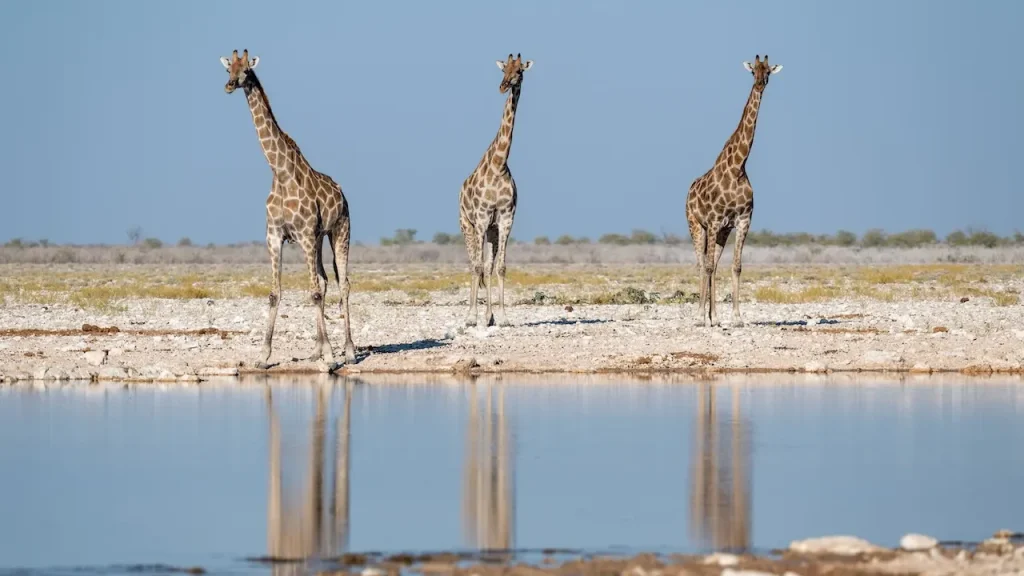
There is something about a giraffe that resists being taken for granted. After years of seeing them, on multiple trips across southern and eastern Africa, the first giraffe of any new visit still produces an involuntary pause. They are simply too implausible. The neck alone accounts for nearly half the total height of up to six metres. The legs are longer than most people are tall. And yet the animal moves with a fluid, rocking grace that makes its proportions seem somehow inevitable.
In Etosha, giraffe are reliably present throughout the park and are visible on almost every circuit. They attract less visitor attention than lion or rhino, which means waterhole encounters with giraffe are often unhurried and uncompeted, just you, a few vehicles, and five or six of the world’s tallest animals going about their business.
Behaviour Worth Watching
Drinking
The giraffe drinking posture is one of the great wildlife sights and an engineering marvel in biological form. Because the giraffe’s head is six metres above the ground and its heart must pump blood through an enormous vertical distance, the animal’s cardiovascular system is extremely high-pressure. Lowering the head to water level risks a surge of blood to the brain, which the giraffe manages through a series of pressure-regulating valves in the blood vessels of the neck.
The posture that results, front legs splayed wide apart, head lowered between them, neck stretched to reach the waterhole surface, is awkward, vulnerable, and visually extraordinary. A giraffe at water is momentarily unable to run or to use its most effective defensive weapon (a kick from the front legs); predators time attacks accordingly, and giraffe approach waterholes with visible caution.
At Kalkheuwel and Klein Namutoni, giraffe can be watched drinking at close range from the vehicle pulloffs. Allocate at least thirty minutes at a productive giraffe waterhole; the approach sequence, the drinking posture, and the withdrawal are all worth observing in sequence.
Necking
Male giraffes compete for dominance through necking: swinging the neck like a pendulum to deliver blows with the head and horns (ossicones) against the neck and flanks of a rival. Full-power necking between adult males is one of the more startling wildlife sights in Etosha; the sounds of contact carry across considerable distance. Young males neck-spar from an early age in a more playful register.
Feeding
The feeding behaviour is as remarkable as the drinking. The eighteen-inch tongue, darker at the tip than at the base, wraps around acacia branches and strips leaves with practiced precision. The giraffe feeds primarily on acacia and in the dry season can subsist on moisture from leaves when no free water is available. Watching a giraffe feeding in an acacia provides close-range observation of the tongue and feeding mechanics that waterhole visits do not.
Best Locations
Kalkheuwel waterhole in the eastern section is the most reliable giraffe waterhole in the park. Herds of ten or more individuals are regularly present, and the drinking sequence can be observed for extended periods.
Klein Namutoni is productive for giraffe alongside black-faced impala, making it one of the best combined wildlife stops in eastern Etosha.
The road between Namutoni and the eastern circuit passes through acacia woodland where giraffe are frequently encountered feeding.
Throughout central Etosha: Giraffe are visible on virtually every circuit between the main waterholes. They are conspicuous over the acacia bush from considerable distance, making them the easiest species to spot from a moving vehicle.
Fotografie
Giraffe offer some of the most compositionally interesting wildlife photography in Etosha. The neck against open sky, the full body at a waterhole, and the head-on approach with the face filling the frame are all strong image types.
For the drinking posture specifically, a medium telephoto (200 to 300mm) framing the full spread of the front legs and the lowered head works well. The low angle of the head relative to the waterhole surface means positioning your camera at window height rather than above the door frame produces better results.
Die Etosha photography guide covers the specific waterhole positioning for giraffe photography.
NWR-Campingplatzreservierungen und Fahrzeugvermietung bis hin zu Aufenthalten in privaten Lodges im NamibRand sowie geführten Dünen-Fotografieprogrammen.