
Cheetah in Etosha: Hunting on the Open Plains
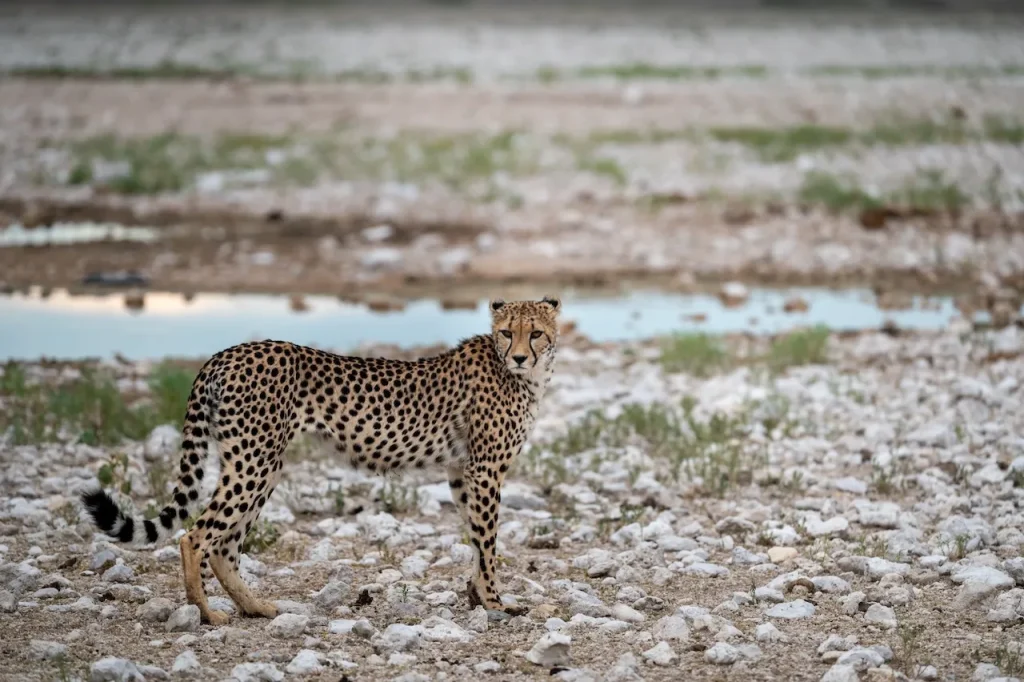
In a dense bush environment, a cheetah hunt is a sequence of sounds and impressions: a rustle of grass, a burst of speed you only half-see, and then either a kill or nothing. In Etosha’s open terrain, it is a different experience entirely. A cheetah beginning a stalk on the open plains south of Okaukuejo is visible from two kilometres in good light. You can watch the approach, the freezing into position when the prey looks up, the recommencement of movement when the prey looks away, and then, if the hunt succeeds, the chase at full speed across flat ground. There is nothing else quite like it in wildlife viewing.
Etosha is consistently rated among the best parks in Africa for cheetah sightings, and the reason is terrain. The open plains of the western and central sections give cheetah nowhere to hide, which means they are more visible than in bushed environments, and which also means their hunting behaviour is more fully observable.
Cheetah in Etosha: The Basics
Cheetah (Acinonyx jubatus) are the fastest land animals on Earth, capable of reaching 110km/h in short bursts. Unlike lion and leopard, they are diurnal hunters, relying on vision rather than scent for hunting, and are most active in the early morning and late afternoon. This diurnal pattern, combined with Etosha’s open terrain, makes them significantly more visible than the nocturnal or crepuscular large predators.
Cheetah are Vulnerable globally, with the African population estimated at under 7,000 individuals. Namibia holds one of the largest cheetah populations outside protected areas of any country in Africa, primarily on commercial farmland, but Etosha’s resident population provides the most reliable opportunity for extended observation.
Where to Find Cheetah in Etosha
Salvadora waterhole area is the most reliably productive cheetah location in the park. The open plains surrounding Salvadora are prime cheetah hunting territory, and resident individuals or coalitions are regularly reported here. The Salvadora waterhole guide covers the approach roads and the best circuit combination.
Okaukuejo plains (the open grassland south and south-west of Okaukuejo camp) hold resident cheetah and are worth slow, searching drives in the early morning. The flat terrain makes distant scanning productive.
Gemsbokvlakte area is another productive open plains cheetah location in the central section, particularly for coalitions of males.
The road between Okaukuejo and Halali passes through a mixture of open plain and light bush that is productive cheetah habitat. Drive this road slowly in the first two hours after gate opening.
Reading Cheetah Behaviour
Understanding cheetah body language from a vehicle significantly improves the quality of an encounter.
Scanning posture: A cheetah sitting upright with its head raised and eyes moving systematically across the landscape is actively searching for prey. Stay very still. This is the pre-hunt phase.
The low stalk: Head dropped, body flattened, one slow careful step at a time. The cheetah has identified a target. This can last twenty minutes for a single stalk attempt. Do not rev the engine.
The freeze: When prey looks in the cheetah’s direction, the cat freezes completely, sometimes mid-step. The patience involved is remarkable. The freeze can last several minutes before the prey looks away and the stalk recommences.
The chase: Explosive acceleration from a standing start to full speed within two or three strides. The characteristic black tear marks from eyes to jaw are most visible when the face is turned toward you. The chase typically covers 200 to 400 metres; if the cheetah has not made contact within that distance, it gives up and allows its heart rate to recover.
Post-hunt panting: A successful hunt leaves the cheetah breathing at an extraordinary rate, recovering from the metabolic demands of the sprint. An animal that has just made a kill will typically pant heavily for ten to fifteen minutes before beginning to feed.
Cheetah and Other Predators
Cheetah cannot compete with lion, leopard, or spotted hyena at a carcass. Larger predators and even large vulture flocks will displace a cheetah from a kill. As a result, cheetah often drag kills into cover and feed quickly. In Etosha, where the terrain is open and lion are common, cheetah encounters near kills are often brief: the animal feeds urgently and moves on before competition arrives.
This dynamic makes the pre-kill observation phase, the stalk and the hunt, more rewarding than fixating on a kill that may be taken within minutes.
Fotografie
Cheetah in Etosha offer outstanding photography opportunities due to the open terrain and diurnal activity pattern. Early morning light illuminates the spotted coat beautifully, and the open ground allows full-body compositions that are impossible in bush environments.
A 200 to 400mm lens covers most cheetah shooting situations. During a hunt, a fast shutter speed (1/1000 second or faster) is essential to freeze the action; in the early morning light, this will push ISO requirements. The Etosha photography guide covers open-plains wildlife photography in detail.
Contact Mat-Travel to structure an Etosha visit around the best cheetah timing and locations.
NWR-Campingplatzreservierungen und Fahrzeugvermietung bis hin zu Aufenthalten in privaten Lodges im NamibRand sowie geführten Dünen-Fotografieprogrammen.