
The Eduard Bohlen: Namibia’s Most Accessible Shipwreck
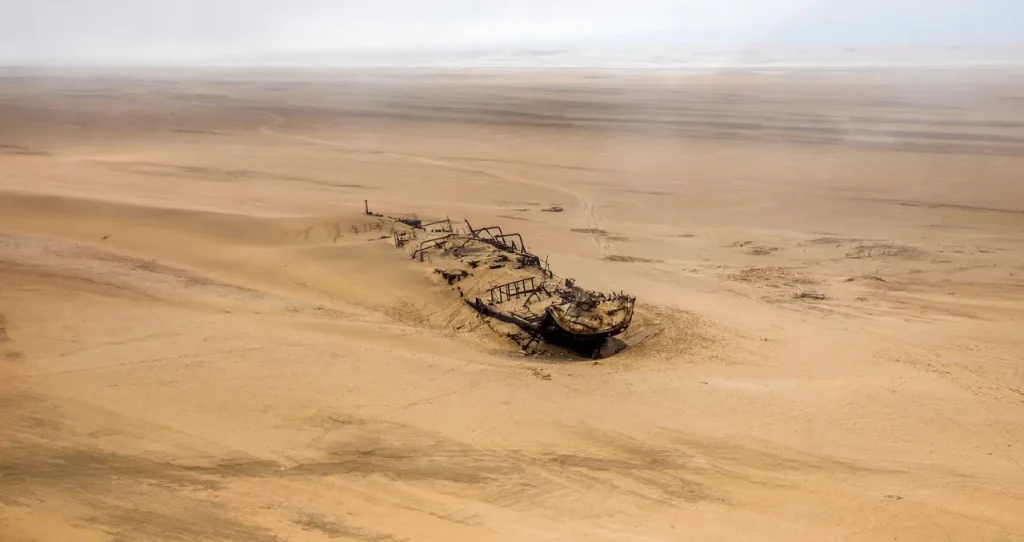
The Eduard Bohlen wrecked in September 1909 when the German cargo vessel ran aground in fog south of Sandwich Harbour. This was not unusual on the Skeleton Coast, the fog and the offshore sand bars made groundings relatively frequent. What is unusual about the Eduard Bohlen is what happened to the wreck afterward.
The coastline shifted. Sand accumulated on the landward side of the wreck while the ocean receded slightly. Today, the rusting hull of the Eduard Bohlen sits approximately 500m from the waterline, surrounded by sand dunes, looking from a distance like a ship that has sailed into the desert. It is one of the most photographically striking industrial-decay images in Africa.
Access
The Eduard Bohlen sits south of Sandwich Harbour, roughly 60km south of Walvis Bay, on a section of coast accessible only by driving along the beach at low tide.
Guided tour: The same operators who run Sandwich Harbour tours from Walvis Bay can combine the Sandwich Harbour visit with an Eduard Bohlen approach. The operators know the tidal windows precisely.
Scenic Flight: Eine Swakopmund Scenic flight allows you to see the Eduard Bohlen shipwreck from the air.
The Photography
The wreck reads best in low, raking light: dawn from the east catches the hull in warm tones; dusk from the west produces silhouette compositions. The fog window, in the early morning before the Benguela fog burns off, produces the most atmospheric images, with the hull emerging from mist against the dune background.
Focal length: wide angle (16 to 24mm) for the hull-in-landscape compositions; medium telephoto (70 to 135mm) for hull detail and the specific textures of 115 years of salt corrosion.
The Story
The Eduard Bohlen was on a voyage from Swakopmund with general cargo when it struck the offshore sand bar in fog. The crew was rescued; the cargo was salvaged over several weeks. The hull was left. In 1909, the wreck was at the waterline. In 2026, it is 500m from the ocean. The rate at which this desert coastline can shift is part of what makes the Skeleton Coast so geologically active and so visually dramatic.
NWR-Campingplatzreservierungen und Fahrzeugvermietung bis hin zu Aufenthalten in privaten Lodges im NamibRand sowie geführten Dünen-Fotografieprogrammen.